"Later, one summer night in 1949,
again the Buddha appeared to me,
in my cell, beside my pillow.
He told me:
The Shimoyama Case is a Murder Case.
It is the son of the Teigin Case,
it is the son of all cases.
Whoever solves the Shimoyama Case,
they will solve the Teigin Case;
they will solve all cases."
—"Sadamichi Hirasawa", a poem, from Natsuame Monogatari, by Kuroda Roman, translated by Donald Reichenbach
Two of the cases mentioned in the verse above, the Shimoyama case and the Teigin case, form the basis of two out of the three novels David Peace's now-complete Tokyo trilogy—the works in question being Tokyo Redux (2021) and Occupied City (2009), respectively. One of these, the Shimoyama incident, concerning the death of Sadanori Shimoyama, the first president of the Japanese National Railways, is officially listed as unsolved, even after nearly 74 years of its occurrence, while the other, the Teigin Bank Massacre of 1948, was a highly contentious affair, with the accused (Sadamichi Hirasawa) serving a death sentence for over 30 years, despite several retrials and no minister of justice ever signing Hirasawa's death warrant. Given the nature and legacy of the two cases, it is no surprise that both of them captured the imagination of the country's masses for decades, and continue to do so to this day.
Let's not bury the lede here—Tokyo Redux is an extremely clever feat of narration that blurs the boundaries between reality, history and imagination supplemented by the former two. It is also, stylistically, an incredibly accomplished work. But, a lot of the credit also goes to its subject matter, the Shimoyama case, the ambiguous and unsolved nature of which invites intelligent, well-measured speculation and manipulation. Tokyo Redux promises to be a great read for anyone sufficiently invested in detailed and well-researched conspiracy theories (paradoxical however it may seem).
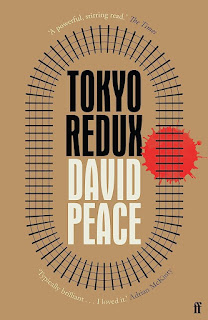
Peace may be best known for his football books, The Damned United ("a fiction" based on Brian Clough's ill-fated managership of Leeds United) and Red or Dead (detailing Liverpool legend Bill Shankly's stewardship of the club between 1959 and 1974), but in crime-writing, particularly noir fiction, circles, he is hailed as an exceptional prose innovator and stylist. In Tokyo Redux, Peace displays the aforementioned virtues and much more. The novel begins with the discovery of a body on the outskirts of Edinburgh in the late 1980s (circa 1988–1989). Certain items found at the scene of the crime—an alarm clock, a newspaper clipping, a photograph and a picture postcard with a certain message scribbled behind it—connects this incident to the death of president Shimoyama on July 5, 1949. It also leads readers directly into the first of three neatly demarcated sections, each possessing identities of their own.
***
The first section, titled The Mountain of Bones, takes one back to the Tokyo of July 1949—a period when the American Occupation was in full force. Even with the challenge posed by criminal gangs and the protests by the communists, the administration is rudely jolted further more when president Shimoyama goes missing on July 5. The Public Safety Division (PSD) springs into action especially as its lead investigator, Harry Sweeney, receives a mysterious call just before the news of Shimoyama's disappearance breaks out. What follows next is a rigorous but speculative retracing of the steps Shimoyama took and the places he visited (for instance, the Mitsukoshi Department Store in Nihonbashi and the Chiyoda Bank near Tokyo station); however, Shimoyama's dismembered corpse is discovered after midnight, apparently having been run over by a train on the Jōban Line near Ayase station in Adachi in north Tokyo.
The course of investigation over the next few days, besides throwing Sweeney's life completely off-kilter, also takes Sweeney and his team over a vast cross-section of Tokyo's landscape, not just in a geographical sense but in socio-economic terms as well. Shimoyama's death is more than it seems—and the more the PSD investigates, the more the number of threads emerge. Investigating these threads leads Sweeney and his team to various locations—from the posh neighbourhoods of Tokyo to the seats of administrative power, department stores, banks, railroad shanties, red light districts and seedy joints frequented by the underworld. Due to the large web spreading out of Shimoyama's influential connections and interpersonal relationships, Sweeney ends up visiting a large, diverse cast of characters—Shimoyama's assistant, family members, members of the upper echelons of the General Headquarters, Supreme Commander for the Allied Powers (GHQ-SCAP), an underworld don, a shamaness, Shimoyama's ex-mistress. Most of these interactions provide brief snippets not only into the lives of the characters, but also constitute pieces, earned painstakingly, of what would ultimately prove to be Sweeney's fruitless investigation. Needless to say, while this section has something of a hardboiled edge to it, it is also easily that portion which resembles a whodunnit the most. Sweeney faces challenges and pressures from both seen and unseen quarters—the GHQ-SCAP is more than willing to lay the blame on the communists, especially since members of the party, besides organising citywide protests against the railways' decision to fire several thousand employees, had also sent threats to Shimoyama, while a section of the police is happy to close the case as a suicide; an underworld don, on the other hand, pulls strings behind the scenes to incriminate Korean immigrants (one of whom also turns out to share a link with the infamous Zed Unit, an international covert ops organisation that saw action mainly in China and Korea).
 |
Sadanori Shimoyama, the ill-fated,
first president of the
Japanese National Railways |
The spotlight, however, shines solely on Sweeney, from an individualistic point of view. The case takes a heavy toll on Sweeney, the sordidness of which is laid out in excruciating, all-too-literal detail. The microscopic focus extends not only to his actions, but also to Sweeney's thoughts. For instance, the section after Sweeney returns to a hotel at the end of a particularly long, tiresome day reads as follows:
"Harry Sweeney put the key in the lock of the door to his room in the Yaesu Hotel. He turned the key, he opened the door. He shut the door behind him, he locked the door behind him. He stood in the center of the room and he looked around the room. In the light from the street, in the light from the night. The screwed-up envelope, the torn-up letter. The open Bible, the fallen crucifix. The upturned suitcase, the empty wardrobe. The pile of damp clothes, the bundle of soiled sheets. The bare mattress, the empty bed. He heard the rain on the window, he heard the rain in the night. He walked over to the washstand. He looked down into the basin. He saw the shards of broken glass. He looked back up into the mirror, he stared at the face in the mirror. He stared at its jaw, its cheek, its eyes, its nose, and its mouth. He reached up to touch the face in the mirror, to trace the outline of its jaw, its cheek, its eyes, its nose, and its mouth. He ran his fingers up and down the edge of the mirror. He gripped the edges of the mirror. He prized the mirror off the wall. He crouched down. He placed the face of the mirror against the wall beneath the window. He started to stand back up. He saw spots of blood on the carpet. He took off his jacket. He threw it onto the mattress. He unbuttoned the cuffs of his shirt. He rolled up the cuffs of his shirt. He saw the spots of blood on the bandages on his wrists. He undid the buttons of his shirt. He took off his shirt. He tossed it onto the mattress. He took off his watch. He dropped it on the floor. He unhooked the safety pin that secured the bandage on his left wrist. He put the pin between the faucets of the washbasin. He unwound the bandage on his left wrist. He threw the length of bandage on top of his shirt on the mattress. He unhooked the safety pin that secured the bandage on his right wrist. He put it next to the other safety pin between the faucets. He unwound the bandage from his right wrist. He tossed this length of bandage onto the other bandage on top of his shirt. He picked up the trash can. He carried it over to the basin. He picked out the pieces of broken glass. He put them in the trash. He turned on the faucets. He waited for the water to come. To drown out the rain on the window, to silence the rain in the night. He put the stopper in the basin, he filled the basin. He turned off the faucets. The sound of the rain on the window again, the noise of the rain in the night again. He put his hands and his wrists into the basin and the water. He soaked his hands and his wrists in the water in the basin. He watched the water wash away the blood. He felt the water cleanse his wounds. He nudged out the stopper. He watched the water drain from the basin, from around his wrists, from between his fingers. He lifted his hands from the basin. He picked up a towel from the floor. He dried his hands and his wrists on the towel. He folded the towel. He hung the towel on the rail beside the basin. He walked back into the center of the room. In the light from the street, in the light from the night. He held out his hands, he turned over his palms. He looked down at the clean, dry scars on his wrists. He stared at them for a long time. Then he knelt down in the center of the room. By the screwed-up envelope, before the torn-up letter. The scraps of paper, the scraps of phrases. Betrayal. Deceit. Judas. Lust. Marriage. Sanctity. My religion. You traitor. Will never give up. Give you a divorce. I know what you are like, I know who you are. But I forgive you, Harry. The children forgive you, Harry. Come home, Harry. Please just come home. Harry Sweeney brought his palms together. Harry Sweeney raised his hands toward his face. He bowed his head. He closed his eyes. In the middle of the American Century, in the middle of the American night. Bowed in his room, his hotel room. The rain on the window, the rain in the night. On his knees, his stained knees. Falling down, pouring down. Harry Sweeney heard the telephones ringing. The voices raised, the orders barked. The boots down the stairs, the boots in the street. Car doors opening, car doors closing. Engines across the city, brakes four stories below. Boots up the stairs, boots down the corridor. The knuckles on the door, the words through the wood: Are you there, Harry? Are you in there?"
The reason I have quoted this section in its entirety is to illustrate the numbing effect of this immensely hardboiled piece of narration and characterisation here. The blow-by-blow account of every single one of Sweeney's actions and thoughts beats one's mind into submission, not unlike the effect produced by blunt-force trauma. This treatment is extended all through the novel, whenever Sweeney takes centrestage. In another instance, while strolling along the Sumida river, Sweeney's mood, ruminations and the surrounding cityscape come together and supplement each other as follows:
"Harry Sweeney turned and started to walk away from the station, away from the store, across Avenue R, toward the river, the Sumida River. He walked into the park, through the park, the Sumida Park. He came to the river, the banks of the river. He stood on the bank and he stared at the river. The current still, the water black. There was no breeze, there was no air. Only the stench of sewage, the stink of shit. People’s shit, men’s shit. The stench always here, the stink still here. Harry Sweeney took out his pack of cigarettes and lit one. By the river, on her bank. The streets behind him, the station behind him. All the streets and all the stations. He stared down the river, into the darkness, where its mouth would be, where the sea would be; across the ocean, there was home. A dog barked and wheels screamed, somewhere in the night, somewhere behind him. A yellow train was pulling out of the station, the yellow train crossing an iron bridge. The bridge across the river, a bridge to the other side. Going east, going north. Out of the city, away from the city. Men disappearing, men vanishing. In the city, from the city. On its streets, in its stations. Their names and their lives. Disappearing, vanishing. Starting afresh, starting again. A new name, a new life. A different name, a different life. Never going home, never coming back. The train disappearing, the train vanishing.
Harry Sweeney looked away from the bridge, stared back down at the river, the Sumida River. So still and so black, so soft and so warm. Inviting and welcoming, tempting, so tempting. No more names and no more lives. Memories or visions, insects or specters. So tempting, very tempting. An end to it all, an end to it all. The pattern of the crime precedes the crime. The end of his cigarette burning his fingers, blistering their skin. Harry Sweeney threw the butt of his cigarette into the river. This dirty river, this stinking river. People’s shit, men’s shit. He turned away from the river, walked away from the river, the Sumida River. Back to the station, back down the steps. Away from the river, the Sumida River, and away from temptation, away from temptation. The pattern and the crime. Disappearing, vanishing. Into the night, into the shadows. Under the city, under the ground."
Once again, a constant hypervigilant focus on and repetition of key patterns, thoughts and associations creates a numbing, sombre mood for Sweeney and the readers—a mood that rarely lets up through the novel. However, the flipside of this highly stylistic exercise is that Sweeney's colleagues (such as Bill Betz and Susumu Toda) and the rest of the supporting cast are not even afforded a third of the limelight Sweeney gets in the first section. They keep appearing and disappearing, flitting around like phantoms which only adds, perhaps, to one key essence of the novel—that of events and ghosts of the past casting long, sinister shadows.
***
If The Mountain of Bones presented post-War Tokyo in all its dirtiness and filth through an exploration of its geography, socio-economic conditions and characters, the second section titled The Bridge of Tears achieves the same effect through different means and in a far more sinister fashion. The scene shifts to 1964 Tokyo during the time of the Olympics—a period that Peace, in the voice of one of the characters, succinctly describes as "Edo stench, Olympic noise". To achieve its purpose, this section employs the trope of a detective lost in the maze of a rapidly modernising city (with a dark underbelly) to devastating effect—a trope that has been quite popular, in a postcolonial context and era, in Japan and the world over.
 |
President Shimoyama's remains being
removed from the Jōban Line |
Murota Hideki, a somewhat down-on-his-luck, crooked policeman-turned-private detective is handed a missing-person investigation by a publishing house. The author in question is Kuroda Roman, who had apparently pocketed some advance fees without furnishing the requisite manuscript. Kuroda Roman, it turns out, was a popular author for some years during the post-1945 Shōwa era, at which time he gained some notoriety before disappearing completely from public view. What seems to be a routine investigation turns on its head when Hideki finds out that Roman had penned a pretty revelatory entry on Hideki himself, dating back to his days as a policeman, in one of his books. Furthermore, in Roman's address book, Hideki finds out that his residence and contact detail have also been listed, without him being none the wiser. What finally signals Hideki's spiralling descent into madness and a sinister plot far beyond his ability to comprehend and his ability to fight back is his discovery of a manuscript titled Natsuame Monogatari, or Tales of the Summer Rains, written jointly by Kuroda Roman and Shimoyama Sadanori. It is a development that inextricably ties the events of 1964 with the Shimoyama Case of 1949.
Partly because it is framed as a narrative portraying a person suffering from personal nightmares, while being trapped in the machinations of others, The Bridge of Tears reads faster and features more tighter prose than The Mountain of Bones. It also helps that much of the groundwork, in terms of key themes (vis-à-vis corruption, abuse of socio-political and economic power, racial tension, among others) is painstakingly laid out in the first part. So, how does The Bridge of Tears go about reinforcing an already dark and depressing atmosphere, other than the plot itself? One of the more interesting ways it does so is by a rhythmic repetition of certain sounds that also act as particular signifiers. If The Mountain of Bones saw a geographical mapping of Tokyo, The Bridge of Tears introduces a novel onomatopoeic mapping. For instance, 'ton, ton' represents sounds of construction, 'shu, shu, pop, pop' stands for the sound of a train's steam engine, the 'murder weapon' in Shimoyama's death, while the sounds signifying ghosts and phantoms of the past inhabiting and passing through empty, shadowy, dilapidated spaces is dramatically represented as 'sā, sā, rei, rei'. The repetition of these sounds at key intervals creates an effect similar to the chanting of Buddhist sutras in monasteries, as far as the setting of particular moods is concerned.
The postcolonial nature of the narrative here also plays a major role here. For Hideki, the deep-dive into the past and the search for the remnants of Roman's presence transforms the Tokyo of 1964, caught in the crossroads of modernity and tradition, into an unfathomable monster whose inhabitants ambush one at every conceivable corner. Despite his training as a policeman and a private detective, Hideki is unable to see the dangers as they approach him—the deceitful clients, the lying people he interviews in course of the investigation and an unseen, powerful enemy that traps him leaving him no room for escape. As a result, he finds himself indicted in a murder case, two cases of assault and the disappearance of his own common-law life. It's a fate that, in its inevitability and hopelessness, closely and curiously resembles that of Kuroda Roman from a decade-and-a-half ago. As is revealed, after realising the extent of his participation in the Shimoyama case, Roman too found himself utterly helpless despite appealing to the police and the institution of Mystery Writers of Japan, ultimately being threatened and manipulated like a puppet in the hands of insidious forces whose presence he is constantly aware of but can do nothing about. And, it is here that the book-in-book structure that is employed half-way into the section displays its full utility. After Hideki discovers the manuscript of Natsuame Monogatari, Peace intersperses the action, unfolding in real time, which Hideki is involved in with excerpts from the book detailing Roman's surprising and deep-rooted involvement in the 1949 Shimoyama case from its earliest days, way before its commission. The purpose is perhaps to draw parallels between Roman's plight in the past and Hideki's fate unfolding in real time, but these passages also reveal much about the Shimoyama case that was left unsaid and unrevealed in The Mountain of Bones. Some characters with an almost shadowy, transient presence in the first half, who reappear in The Bridge of Tears, are also revealed to have played very important roles in the lead-up to and in the aftermath of the Shimoyama case.
The resulting effect is that Hideki not only finds himself caught in the web of a nightmarish conspiracy that extends from the past to the present, he also ends up as a victim of Kuroda Roman's and Sadanori Shimoyama dark legacy—the book, Natsuame Monogatari, which, if published, was, ironically, meant to be a tell-it-all account and a means to escape the clutches of the perpetrators of the Shimoyama murder case. Perhaps, Hideki's and Roman's fate do not exist on parallel tracks; they converge with only one possible outcome—madness, that hits both characters with the speed and force of a freight train. The element of madness adds yet another dimension to an already dark narrative, and it all culminates in a frighteningly spectacular scene in a mental asylum under the aegis of the 'Department of Psychic Seances'. The seance held at the end of The Bridge of Tears—akin to a lucid, fever dream which would have been completely at home in a novel like Dogura Magura (1935), author Yumeno Kyūsaku's surrealistic tour de force—sees an uncomprehending Hideki gliding through the spectres of cases past in a pantomime of a performance conducted for supposedly 'scientific reasons'. The figures in this performance include Kuroda Roman himself, Sadamichi Hirasawa (of Teigin Bank Massacre fame), and perhaps, most significantly, the figure of Harry Sweeney who clutches a broken teddy bear and softly whispers "It's too late" (a recurring motif and statement seen throughout the novel) just as the 15-year statute of limitations expires for the Shimoyama case.
***
More skeletons and secrets tumble out of the Shimoyama case closet in The Gate of Flesh, the last of the aforesaid three sections. Set towards the end of 1988, only a month or two away from the death of Emperor Hirohito, this concluding part is as much about the passing of an era (the Shōwa era) as it is about displaying the grasp the Shimoyama case had on each of the individuals involved prominently, till the moment of their deaths.
 |
An inspection of the locomotive
that hit Shimoyama |
The spotlight this time falls on the hitherto-unseen Donald Reichenbach, a professor and the translator of the verse mentioned at the start of this essay. It is through his eyes and memories that Peace lays forth his interpretation of the facts in the Shimoyama case and posits a plausible solution to the case. While the major perpetrators and much of the main conspiracy are pretty much revealed in act two, Reichenbach and his fellow cast of characters play roles that effectively prevented Sweeney and his team from getting to the bottom of the case in act one itself. In this third act, however, Reichenbach emerges as a rapidly ageing, broken-down, lonely man who is fast running out of friends and company, mainly due to his refusal and inability to let go of the past, and always returning to the scenes of his past crimes, despite undergoing psychiatric treatment. Through the course of this section, even though his colleagues have moved past the Shimoyama incident and its long aftermath, Reichenbach finds himself unwittingly visiting some of the locations pertaining to the incident, almost like a ghost incapable of setting itself free off a haunted house. Here too, Peace utilises flashbacks into the past, shuttling alternately between 1949 and 1988, to reveal the incidents that the locations were witness too. While in the previous act, the alternating past-and-present narratives focussed more on the characters themselves, the focus of these flashbacks in this act seems to have shifted to the locations themselves, as mute, silent and impartial witnesses. This treatment may just be what the doctor ordered, because once the entire picture emerges, the sordidness, inhumanity and callousness underlining the Shimoyama case, as deduced by Peace, is simply too shocking. Briefly said (and spoilers ahead), Peace indicts the Central Intelligence Agency (CIA), the Zed Unit (and, in close collaboration with it, the Hongō House) and the SCAP to varying degrees, with the unsettling revelation that the upper echelons of each of these organisations were aware of the political moves they were plotting against each other, while many of the foot-soldiers and the bits-and-pieces players were kept in the dark till the endgame, so that they could fulfill their role as scapegoats better. With its focus on secret organisations and internal politics, Tokyo Redux reminds me of Nagasaki Takashi and Kouno Kouji's manga, Inspector Kurokochi (2012), which, even if tonally disparate from Peace's work, takes on another yet-unsolved crime that is often considered to the holy grail of Japanese mysteries—the 300 million yen affair or robbery from 1968—and also indicts a clandestine, shadowy institution in the process.
It is, perhaps, fitting then that, as the past rapidly catches up to him, Reichenbach is subject to the same terror that Hideki, Sweeney and Roman were subject to—the fear of an unknown, powerful enemy, except that, in Reichenbach's case, the enemy is a vengeful one as well. Ultimately, Reichenbach, fearful of death, is made to bear the weight and responsibility of the Shimoyama case as he meets an ignominious end, falling down a flight of stairs—"down the steps, down, down, down, down, down, down, down, down, down, down, down, down, down, down, down, down, down, down, down, down, down, down, down, down, down, down, down, down, down, down, down, down, down, down, down, down each one, each single one of the thirty-six steps to the ground ... "
***
Tokyo Redux is a hefty novel that is, perhaps, well worth the ten-plus years it took Peace to research and write. In the way it presents conflicting perspectives, it resembles, in my opinion, Ryūnosuke Akutagawa's short story, "In A Bamboo Grove"—but only to a certain extent, because, for one, the misinformation and deception is deliberate in a relatively linear story (it's not that the readers see different truths as much as they are made to see manufactured ones), and secondly, at the end of it all, Tokyo Redux provides a concrete solution to the Shimoyama case, and does not leave it to the imagination and judgement of the readers. Besides its stylistic and narrative achievements, it is also an incredibly immersive book and it is easy to lose oneself in the noirish underbelly of the Tokyo of the past, as portrayed here. And, despite his well-documented repugnance towards considering crime fiction as a puzzle game/game of logical reasoning, Peace does employ a bit of the essence of a whodunnit (not a fair-play one though) in this work, bringing the narrative to a well-reasoned-out conclusion. However, the most telling and impressive evidence of Tokyo Redux as a historical, conspiracy thriller of the first order comes in the End Matters portion of the book, where Peace hints that his entire understanding and reasoning of what actually happened in the Shimoyama case hinges upon the singular fact that "the sections for Japan in the weekly intelligence summaries provided by the Office of Reports and Estimates, CIA Far East/Pacific Branch remain redacted for the period around the death of Sadanori Shimoyama. And for only that period."
As my first tentative and experimental stab at Peace's crime fiction, Tokyo Redux proved to be a lot more than I had bargained for—in a good, fruitful way, of course. I will be covering more of Peace's works on this blog in the future, as and when I come across them. For the time being, however, my first order of business will be to complete the Tokyo trilogy—from the back forwards, which will be another first for me.


