Sunday, January 30, 2022

Soji Shimada's Bloody Christmas Gifts

This post comes more than a month late—I had initially planned to put this up on Christmas day, 2021. But, being part of a travel-magazine team and some COVID-19-related complications ensured that things rarely happened according to plan over the past few months.

Anyway, in 2018 and 2019, I encountered what are widely considered to be seminal works for a new generation of Japanese crime-fiction authors (the shin honkaku school that has already been referenced earlier on this blog). Both of them—The Tokyo Zodiac Murders (originally published in 1981 as Senseijutsu Satsujin Jiken or The Astrology Murder Case) and Murder in the Crooked House (published as Naname Yashiki no Hanzai in 1982)—were written by Soji Shimada, and strangely enough, I finished reading both of them on the Christmas days of the respective years. Now, this was not my first stab at Japanese crime fiction, as I had already encountered the Kindaichi and Conan series and a few other titles before this, but it is safe to say that these books together sparked an almost academic interest in this field for me.

At the time I read it, The Tokyo Zodiac Murders ranked among the goriest and bloodiest novels I had the pleasure of reading. It wasn't sufficient that the body count was ridiculously high (seven—no, one may say, eight—victims); seven of these cases involved decapitation and dismemberments. However, it is not the number that is, personally speaking, a point of interest. Instead, it is the purpose of the clever, deliberate and intricate way in which these deeds are carried out that is most intriguing. Works such as Ellery Queen's The Egyptian Cross Mystery (1932) and Takagi Akimitsu's The Tattoo Murder Case (1948) also feature sinister acts of a similar kind, but in these two titles, the aim is to obscure, misinform and befuddle investigators, and to make identification impossible which, in turn, ties into issues of alibi, and estimating and establishing the right time and scenes of the crimes. In The Tokyo Zodiac Murders, the dismemberments serve an altogether different, and far more outrageous goal: to create a 'homunculus' out of thin air—considered by many to be the ultimate alchemical achievement.

This, of course, ties into the introductory part of the story featuring the last will and testament of a certain Heikichi Umezawa, an eccentric painter and astrologer who had taken it upon himself to create Azoth, the 'perfect woman' according to alchemical standards. For this purpose, he intends to sacrifice his six nieces and daughters at astrologically determined, precise spots scattered all across Japan. And sure, soon enough, the women chosen by Umezawa are all slaughtered, and parts of their bodies are found at each of the places indicated by his testament. The problem? Even before these murders took place, the would-be culprit (Heikichi) was found murdered in a locked room surrounded by snow.

Book cover of Soji Shimada's The Tokyo Zodiac Murders, published by Pushkin Vertigo

All of these incidents happened way back in 1936. Forty years later, at the time the book is set, the cases still remain unsolved and have attained a legendary status in Japan, with many books written and numerous theories advanced on the subject. A university professor-cum-astrologer Kiyoshi Mitarai and his friend Kazumi Ishioka come across Heikichi's Azoth manuscript. The details of the three separate cases—Heikichi's death, the murder of Heikichi's stepdaughter and the Azoth slayings—pique the interest of Kiyoshi, who also doubles as an amateur detective from time to time and who makes the bold declaration that he would arrive at the correct conclusion of this unsolved, baffling case within a week, based on the details laid out before him.

And arrive he does! There are some books whose importance cannot be overstated, not based on how likeable and unlikeable the constituent elements are but simply because of what they achieve for a particular genre. In due time, such books become yardsticks to retrospectively measure the progress of the genre and often provide instructive threads, themes and tropes for future authors to replicate or develop in their own fashion. The Tokyo Zodiac Murders is one such book. No doubt, there are a number of inexcusable treatments in this book, especially in the manner in which it treats the characters, especially women. You can even argue that there's a fair amount of 'character assassination' involved (both literally and figuratively) whereby the characters are fed as cannon fodder and treated as mere pieces in a larger puzzle game. In that respect, the book lacks a certain sense of humanity at its core, and the players, both old and new, all show their nastiest traits and rigid dogmatic views at different sections. Worst of all, the abysmal treatment of the cast only largely furthers the purpose of trying to make the culprit a more sympathetic figure. It is also a dig at the tropes and conventions of the social school of mystery writing which was all the rage and which Shimada was trying to overturn when he wrote this book. Be that as it may, there's no doubt that the pathetic portrayal of characters sticks out like a sore thumb.   

There's equally no denying that the execution of the core mystery plot is exemplary and excellent. There's an ingenious—one may even say bombastic—false solution to the mystery of the locked-room conundrum in Heikichi's case. However, the real solution has an elegance comparable to those found in Tetsuya Ayukawa's short stories. When it comes to the six Azoth murders, it is unlikely that you will make the correct deduction, despite the two Challenges to the readers from the author. There's a mathematical complexity to Azoth's existence that may not be everyone's cup of tea. What you will experience, though, is the 'aha' moment when all the jigsaw pieces are fitted together to make perfect sense. It is a glorious vindication of Shimada's vision for the novel—it is his and his alone, and he owns it like a virtuoso. There are lessons to be learnt here for budding authors on how to craft a devious puzzle, and it is little wonder that The Tokyo Zodiac Murders paved the way for the birth of the shin honkaku school and its practitioners such as Yukito Ayatsuji and Alice Arisugawa, among many others, in a major way.

***

If The Tokyo Zodiac Murders was all about the excellence of execution of an intricate, complicated puzzle, it is the brilliant central premise of Murder in the Crooked House (Shimada's second novel) that I have the highest regard for.

Murder in the Crooked House is, in essence, a mansion mystery—one that makes use of architectural features and functions more prominently than in its Western counterparts. The Crooked Mansion (or the Ice Floe Mansion) lies somewhere on the edge of a desolate cliff overlooking the icy Okhotsk Sea— a setting and location not entirely unreminiscent of End House in Agatha Christie's Peril at End House. The mansion itself is mazy but with no special features such as hidden panels and secret passages. It however has a special feature. The windows to the north and south are what one normally finds, but those on the east and west have had their frames built to run parallel to the ground outside. And since the mansion is situated on an incline, the visitors feel like "a hard-boiled egg that has been dropped on the floor" and "is trying to roll uphill", much to the amusement of the mansion's owner, Kozaburo Hamamoto, the President of Hama Diesel. There is an adjoining tower built of glass—an exact replica of the Leaning Tower of Pisa with the same tilt—that houses Hamamoto's room and is connected to the main mansion by a drawbridge. At the foot of the tower is a strangely shaped flower garden.

Hamamoto invites a select circle of friends consisting of fellow businesspeople, their wives and secretaries and a few college students to this property for Christmas and New Year. At the party, he also promises the hand of his daughter Eiko to the one who is able to unravel the meaning of the flower garden's layout and design. However, strange incidents start to plague the gathering. A guest sees a long wooden stake in an ice field in the middle of a snow blizzard when earlier there had been none. Another visitor is scared out of her wits by scraping metallic sounds on the ceiling of her room on the topmost floor and a grotesque, unearthly face appearing on one of the windows of the same room. The next day, Hamamoto and his company are shocked to find the corpse of one of the guests in a locked storeroom, his body twisted at an unnatural angle and one of his wrists tied to the foot of the bed. On the way to the room, they also encounter the damaged remains of a life-sized puppet-like doll, the Golem, which Hamamoto had purchased in erstwhile Czechoslovakia.

Book cover for Soji Shimada's Murder in the Crooked House, published by Pushkin Vertigo

The police are called to the scene, but they prove to be none the wiser. Even worse, another mysterious death happens under their watch in a locked room. More attacks on the remaining guests happen. As a last resort, the police decide to call in Kiyoshi Mitarai, a man they deem fit to solve a case such as this.

Unlike The Tokyo Zodiac Murders, Murder in the Crooked House unfolds in real time. The result is a welcome urgency that allows one to witness Mitarai being forced to take sly steps to resolve the matter as soon as possible. This is much unlike The Tokyo Zodiac Murders, where all you see is Mitarai mostly talking to people about past events and then drawing his conclusions based on those conversations. Here though, Mitarai, omniscient and omnipotent though he is in both novels, is a far more active participant even though he appears pretty late in the picture.

Admittedly, the scale and scope of Mitarai's second adventure is far less stunning and impressive—no cut-up bodies or an Azoth-like apparition emerging out of nowhere. The circle of suspects is also very compact. And due to the mechanics of the murders, especially the second (one that reminds me, incidentally, of a Detective Conan episode involving scores of masks and a knife), the whodunnit aspect isn't really a draw. In fact, once you are aware of the central trick employed, the culprit becomes fairly obvious as no one else except that person could have committed it.

For me, three things stand out in Murder in the Crooked House: the way architecture plays an integral role in the events of the novel, the howdunnit aspect of the second murder and the absolutely-nuts central premise of the work. An expensive mansion and tower existing for the sole purpose of murdering a person to honour a promise made to a deceased friend speaks of a directness of thought and approach that is hard not to appreciate. This directness is also reflected in the straightforward path taken by the murder weapon, during the second case, from its source to the intended target. Interestingly enough, all the complexities in the mansion's layout and myriad features (including the wall of masks in the Tengu Room) are only present as accessories and tools to emphasise the singular directness of the aim and intent behind it all. It would seem as though Shimada built the entire novel around a single trick—but what an innovative, awe-inspiring trick that is.

***

Retrospective studies and analyses of Japanese crime fiction often cite these books as turning points in the genre's history in Japan. They may not have been popular when they were published, but the greatest vindication of their virtues has been the emergence of a new sub-genre (shin honkaku) and generations of writers who continue to take notes from or look to them for inspiration and guidance. Sure, both of Shimada's books are flawed reads, and critically so in many respects. However, there is no denying either that decades after they were published, the tenets laid down in these books still act as guideposts and beacons for readers and writers in a country well-known for its involvement and contributions to crime fiction—and for a global audience as well, now that they are in translation. One wishes for more works from Shimada's massive oeuvre to be introduced the world over.

(This post was published on the Scroll website with the following title: What is the shin honkaku sub-genre of mystery? How did Japanese writer Soji Shimada make it popular?)      

Saturday, December 11, 2021

Hard Times

If there is one year I wouldn't want to relive in the future, it would probably be 2021. The deaths of dear friends and numerous casualties among my near and dear ones owing to COVID-19, some recurring health issues (both physical and mental)—this year, the losses have been too many to count and bear.

By November, I thought I had left all of these behind, but then came the calling of a new job and, with it, the shift to a new city that left me severely ill. Settling at a new place and figuring out the logistics of my new workplace also took up a fair amount of time, as a result of which I wasn't able to pay any attention, whatsoever, to this blog for a month-and-a-half.

Cover of Shitauke Tantei Nokori Kasuhiro

Amidst all these hardships, I suppose I owe a debt of gratitude to one of the most hilarious parodic one-shot mystery manga I have had the pleasure of reading which brightened many a dull and dreary evening. Kumeta Kōji's Shitauke Tantei Nokori Kasuhiro (The Cases of Contract Detective Nokori Kasuhiro: Foreign Student in a Locked Room) was the first entry in a collaboration series between art magazines Mephisto and Magazine on the theme of 'locked rooms'. Kōji is well known for his work on Sayonara, Zetsubou-Sensei, a manga series with a suicidal teacher as the protagonist (and his 'students' as the cast), known for its whimsical absurdism, running gags, dark humour, literary references as well as the eccentric analysis of Japanese society and culture.

Kōji's brand of morbid humour and his use of running gags are made evident in this one-shot manga at the very outset of Shitauke Tantei Nokori Kasuhiro. Kasuhiro Nokori is introduced as a contract detective who takes up cases that are simply too 'annoying' for other well-known detectives such as Conan, Kindaichi and Sherdock to solve. It is his assistant Shiyori Jigo who accepts the case the great Nokori will solve within 20-odd pages. From here on, Kōji pokes fun at crime fiction tropes and conventions in side-splitting fashion. To achieve this, Kōji 'elevates' the tropes and conventions to ridiculous, parodic extremes. For instance, in the narration of Kasuhiro's achievements, Shiyori mentions 'legendary' cases which Kasuhiro has solved by (i) making a hundred round trips of the same train route, (ii) adopting a De Niro-like approach and losing 20 kilograms of weight to solve an incident that happened via an opening too narrow for anyone to pass through, and (iii) diving into a barrel of grated yam that left the detective filling itchy for the following two months. Then, there's the introduction of the stock inspector character, who rules everything as a suicide and is thus named 'suicide officer' Shintarou Mizukara.

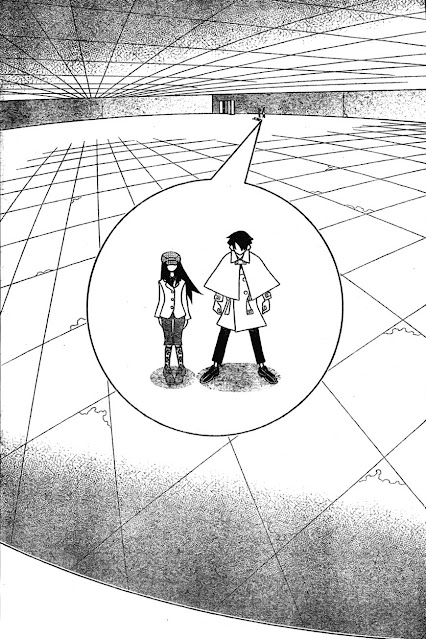
Perhaps, even more ludicrous is the setting of the locked room. Surely, it has to go into the annals of crime fiction as the largest locked room—a square, five-kilometre-by-five-kilometre room where the victim, the suspect, the witness and the murder weapon lying at each of the four corners of this gigantic room. At this point, Nokori starts to realise why the other detectives may have given up on this case (there's a hidden meaning to this, though, and things are not what they may seem at first glance), and indeed, it is possible for one to feel sorry for the detective having to travel to each corner and back, multiple times, to connect the threads of information gleaned from the respective corners. But Kōji never lets go of his sense of humour, and the way he portrays the deduction scenes, especially how a 'runner's high' helps solve the case, will more likely leave you doubled up in laughter than feeling sorry.

The world's largest literary locked room, courtesy Kumeta Kōji and Shitauke Tantei Nokori Kasuhiro
Ladies and gentlemen, the world's largest literary locked room, courtesy Kumeta Kōji and Shitauke Tantei Nokori Kasuhiro

But, laughs aside, Shitauke Tantei Nokori Kasuhiro is an extremely competent mystery with a killer ending, even though it may seem to come slightly out of left field. Admittedly, the clueing and background information are a bit lacking, but there's only that much you can do within 20 pages. These shortcomings are more than compensated by the first-class deception and misdirection that leads directly into the devastating ending which hits the reader like a ton of bricks. What impresses me most about this one-shot is that nearly all the visual elements (the settings, the characters, the material evidences) that are so ruthlessly parodied also hide sinister meanings and implications behind their apparently ludicrous presence. One can sense Kōji's love and faithfulness towards the parody and crime genres, and it is to his immense credit that he is able to successfully merge the two in such a packed space. Ultimately, he pulls off a sensational and brilliant subversion of the locked room sub-genre using the duality of the synergistic elements he portrays—one where the mystery 'inside' the room matters little in comparison to what's happened 'outside' the room, even though the clues to realise the 'outside' events are all locked 'inside' the massive room.

In the last page, Kōji mentions that he would have loved to make this into a series, but this one-shot already seems to be the last chapter. A lost opportunity, I am sure, for us crime-fiction lovers, but I can sense a kind of resonance between my blog's plight and Kōji's unfulfilled manga series featuring the eccentric Kasuhiro Nokori. Moving forward, I am not sure how regular I will be with my writing on this blog, but as long as fulfilling reads such as Shitauke Tantei Nokori Kasuhiro come to my notice, there is always hope. Never say never, as they say.

Sunday, October 31, 2021

Treasure Island

I have an unusually soft spot for mysteries and murders set in islands, and have been fortunate enough to have read and watched some of the best on offer—Shetland (based on Ann Cleeves' Jimmy Pérez books) and Agatha Christie's And Then There Were None come to mind. Japanese authors, in particular, have mastered the art of delivering pitch-perfect island mysteries that utilise the unique environs to perfection—Yukito Ayatsuji's Jukkakukan no Shinsou Kaiteiban (translated into English as The Decagon House Murders), Seishi Yokomizo's Gokumon-tō (Prison Gate Island) or any of the several Kindaichi Shōnen no Jikenbo tales set on isles are only a few that promise a rollicking good time.

Ayatsuji's 1987 novel The Decagon House Murders, a wonderfully original take on the Christie classic And Then There Were None, was a watershed moment in the annals of crime fiction writing in Japan. In it, Ayatsuji lays the foundations of what would later come to be known as the shin honkaku (new orthodox) school of mystery writing—a sub-genre that would, soon enough, lure amateur writers away from crafting social mysteries and later earn a legion of devoted fans whose admiration remains unsullied to this day. Early on in this book, one of the characters articulates what would essentially become a clarion call to future writers of this school. It is worth quoting in its entirety, especially as it aptly describes what the shin honkaku school stands for:

"In my opinion, mystery fiction is, at its core, a kind of intellectual puzzle. An exciting game of reasoning in the form of a novel. A game between the reader and the great detective, or the reader and the author. Nothing more or less than that.

So enough gritty social realism please. A female office worker is murdered in a one-bedroom apartment and, after wearing out the soles of his shoes through a painstaking investigation, the police detective finally arrests the victim's boss, who turns out to be her illicit lover. No more of that! No more of the corruption and secret dealings of the political world, no more tragedies brought forth by the stress of modern society and suchlike. What mystery novels need are—some might call me old-fashioned—a great detective, a mansion, a shady cast of residents, bloody murders, impossible crimes and never-before-seen tricks played by the murderer. Call it my castle in the sky, but I'm happy as long as I can enjoy such a world. But always in an intellectual manner."

In ways both good and bad, the essence of this lengthy, almost Queensian declaration is rendered faithfully in Alice Arisugawa's 1989 work, Kotō Pazuru (literally, Koto Puzzle, translated into English in 2016 with the title of The Moai Island Puzzle). Just like its predecessor (The Decagon House Murders), The Moai Island Puzzle also has a university club of mystery fiction aficionados visiting a remote island that is soon cut off from the mainland by a raging storm, just as the island's residents start getting knocked off one by one. Three members of the Eito University Mystery Club—the narrator Alice, the sleuth Jirō Egami and the club's only female recruit Maria Arima—visit Kashikijima on Maria's invitation to indulge in treasure hunting. Kashikijima is a strange island—not only is it unusually shaped (it looks like a horseshoe magnet), it also has some 25 ominous moai statues looming large over the landscape. These statues also happen to be the focal point of the mysterious treasure—Maria's grandfather hid a large cache of diamonds worth a fortune somewhere on the island with the only hint being the statues and the directions they faced. It is this seemingly unsolved mystery that Jirō and his friends wish to crack now.

There exist only two residences on Kakushijima, one each on the two poles of this horseshoe magnet island. The larger one, Panorama Villa, is hosting a gathering of Maria's extended family members at the time of the mystery club's arrival, while the smaller Happy Fish Villa is home to a moderately successful artist (also one of Maria's relatives) who visits it from time to time. To travel from one to the other, one either needs to take a boat across the bay separating the two, or cover the distance on foot or bicycle courtesy of a road that takes one through the long arc of the island. Both villas soon witness impossible crimes in the midst of a storm. Will  Jirō and his friends be able to solve the puzzle of the treasure as well as that of the three murders that seem to have links with Maria's past and one of her now deceased relatives?

The Moai Island Puzzle

At first glance, this synopsis seems very attractive, but I'll start with the negatives here. The mystery surrounding the treasure, which lends itself to the title, is overlong and clearly overstays its welcome. Excessively laborious in its execution, one plods through this portion in weary anticipation of what they will find at the end of it all. Unfortunately, the puzzle of the statues 'evolves' too much for its own good—one definitely needs to be aware of a certain stream of knowledge to solve this puzzle, and even then, it's quite a stretch to reach the correct conclusion. Perhaps, even more damningly, the payoff is too little for all the struggle one undergoes, making for an extremely poor adventure trip—[SPOILER ALERT] turns out the mystery has already been solved before the arrival of our protagonists, and then, the puzzle and the developments surrounding them essentially become a footnote in the motive behind the cases. Not fair at all, one would say, considering that nearly a 100 pages are devoted to this puzzle and its unravelling!

The first murder also happens pretty late into the novel, but it is the conversations between the (mostly dislikeable) characters preceding it and the way they are portrayed that proceeds to suck all the life away here. There is too much unnatural stiffness in the nature of the dialogue in this section—as though the characters too are eagerly waiting for something to happen to them and that they can't wait any longer to reach the heart of the text. The plot and the puzzles demand that the characters act in certain ways—and they do so, regardless of how unnatural, forced and even unrealistic it may all seem. While such a treatment on Arisugawa's part clearly establishes the primacy of the plot and the puzzles over characterisation, a more competent balancing act would have gone a long way in making it palatable without leaving an unpleasant aftertaste.

The novel really starts shining once the murders are committed. The Moai Island Puzzle is, at its best, a tribute to Queensian and Holmesian aesthetics in the mystery novel—and thankfully, the work provides many instances to showcase both. The Holmesian trait of eliminating all that's impossible and positing whatever remains as the truth is evident in the many discussions between Jirō and his friends where hypotheses are presented and possibilities discounted by all three members of the Eito University Mystery Club, with Jirō acting as the most perceptive and discerning of the lot. And as Sōji Shimada astutely points out in his introduction to the novel, Jirō graduates from being a disinterested, bland, Queensian puzzle maniac to a more proactive Holmes-like figure who definitely acts heroically in a certain aspect towards the end of the novel. If only such a nuanced treatment could have been meted out to the rest of the characters ...

Anyway, the novel does one better when doffing its hat to Ellery Queen. Chains of deduction are built upon minutely detailed timetables drawn by the investigators and very singular observations of particular items and events—[SPOILER ALERT] a boat rown across the bay at a particular time, a light travelling between the two villas at the dead of night, a cycle tyre-mark and a piece of cloth found at particular parts of the island, among others—and linking them all into a linear, cohesive and definitive narrative. The novel is a perfect lesson in crafting chains of logical reasoning on singular observations, clues and items of evidence and also demonstrates why the author needn't 'deceive' readers with a gamut of randomly scattered, possibly relevant clues and/or too many red herrings. It plays it very straight with the dying message too, which just requires one to understand what's 'not present' to properly interpret it.

For those deeply vested in the world of Japanese crime novels, The Moai Island Puzzle can be considered to be mandatory reading. Personally, I find it a most instructive work that provides a fascinating glimpse into the highs and lows of shin honkaku plotting within the space of some 250-odd pages (notwithstanding the fact that it would have benefitted a lot if its length had been reduced by a third). Two different kinds of puzzles are presented in the work with conflicting treatments—one that the authors should aspire to, another they should avoid if they do not want to leave readers feeling short-changed. This, in itself, makes for a very strange balancing act—but one that should perhaps not be attempted at all. 

(This post was published on the Scroll website with the following title: How a Japanese island mystery novel replicated the Ellery Queen and Sherlock Holmes brand of mystery)