Saturday, December 11, 2021

Hard Times

If there is one year I wouldn't want to relive in the future, it would probably be 2021. The deaths of dear friends and numerous casualties among my near and dear ones owing to COVID-19, some recurring health issues (both physical and mental)—this year, the losses have been too many to count and bear.

By November, I thought I had left all of these behind, but then came the calling of a new job and, with it, the shift to a new city that left me severely ill. Settling at a new place and figuring out the logistics of my new workplace also took up a fair amount of time, as a result of which I wasn't able to pay any attention, whatsoever, to this blog for a month-and-a-half.

Cover of Shitauke Tantei Nokori Kasuhiro

Amidst all these hardships, I suppose I owe a debt of gratitude to one of the most hilarious parodic one-shot mystery manga I have had the pleasure of reading which brightened many a dull and dreary evening. Kumeta Kōji's Shitauke Tantei Nokori Kasuhiro (The Cases of Contract Detective Nokori Kasuhiro: Foreign Student in a Locked Room) was the first entry in a collaboration series between art magazines Mephisto and Magazine on the theme of 'locked rooms'. Kōji is well known for his work on Sayonara, Zetsubou-Sensei, a manga series with a suicidal teacher as the protagonist (and his 'students' as the cast), known for its whimsical absurdism, running gags, dark humour, literary references as well as the eccentric analysis of Japanese society and culture.

Kōji's brand of morbid humour and his use of running gags are made evident in this one-shot manga at the very outset of Shitauke Tantei Nokori Kasuhiro. Kasuhiro Nokori is introduced as a contract detective who takes up cases that are simply too 'annoying' for other well-known detectives such as Conan, Kindaichi and Sherdock to solve. It is his assistant Shiyori Jigo who accepts the case the great Nokori will solve within 20-odd pages. From here on, Kōji pokes fun at crime fiction tropes and conventions in side-splitting fashion. To achieve this, Kōji 'elevates' the tropes and conventions to ridiculous, parodic extremes. For instance, in the narration of Kasuhiro's achievements, Shiyori mentions 'legendary' cases which Kasuhiro has solved by (i) making a hundred round trips of the same train route, (ii) adopting a De Niro-like approach and losing 20 kilograms of weight to solve an incident that happened via an opening too narrow for anyone to pass through, and (iii) diving into a barrel of grated yam that left the detective filling itchy for the following two months. Then, there's the introduction of the stock inspector character, who rules everything as a suicide and is thus named 'suicide officer' Shintarou Mizukara.

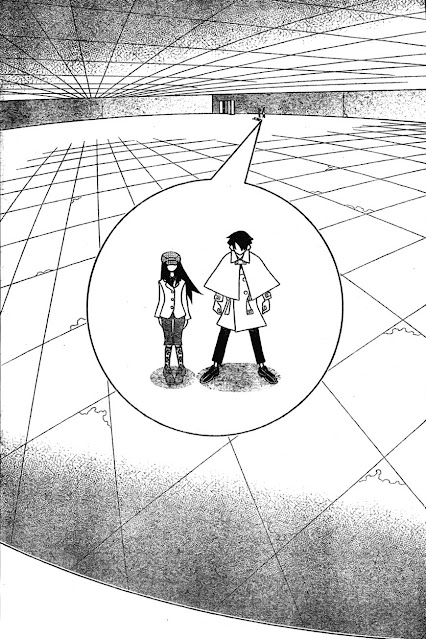
Perhaps, even more ludicrous is the setting of the locked room. Surely, it has to go into the annals of crime fiction as the largest locked room—a square, five-kilometre-by-five-kilometre room where the victim, the suspect, the witness and the murder weapon lying at each of the four corners of this gigantic room. At this point, Nokori starts to realise why the other detectives may have given up on this case (there's a hidden meaning to this, though, and things are not what they may seem at first glance), and indeed, it is possible for one to feel sorry for the detective having to travel to each corner and back, multiple times, to connect the threads of information gleaned from the respective corners. But Kōji never lets go of his sense of humour, and the way he portrays the deduction scenes, especially how a 'runner's high' helps solve the case, will more likely leave you doubled up in laughter than feeling sorry.

The world's largest literary locked room, courtesy Kumeta Kōji and Shitauke Tantei Nokori Kasuhiro
Ladies and gentlemen, the world's largest literary locked room, courtesy Kumeta Kōji and Shitauke Tantei Nokori Kasuhiro

But, laughs aside, Shitauke Tantei Nokori Kasuhiro is an extremely competent mystery with a killer ending, even though it may seem to come slightly out of left field. Admittedly, the clueing and background information are a bit lacking, but there's only that much you can do within 20 pages. These shortcomings are more than compensated by the first-class deception and misdirection that leads directly into the devastating ending which hits the reader like a ton of bricks. What impresses me most about this one-shot is that nearly all the visual elements (the settings, the characters, the material evidences) that are so ruthlessly parodied also hide sinister meanings and implications behind their apparently ludicrous presence. One can sense Kōji's love and faithfulness towards the parody and crime genres, and it is to his immense credit that he is able to successfully merge the two in such a packed space. Ultimately, he pulls off a sensational and brilliant subversion of the locked room sub-genre using the duality of the synergistic elements he portrays—one where the mystery 'inside' the room matters little in comparison to what's happened 'outside' the room, even though the clues to realise the 'outside' events are all locked 'inside' the massive room.

In the last page, Kōji mentions that he would have loved to make this into a series, but this one-shot already seems to be the last chapter. A lost opportunity, I am sure, for us crime-fiction lovers, but I can sense a kind of resonance between my blog's plight and Kōji's unfulfilled manga series featuring the eccentric Kasuhiro Nokori. Moving forward, I am not sure how regular I will be with my writing on this blog, but as long as fulfilling reads such as Shitauke Tantei Nokori Kasuhiro come to my notice, there is always hope. Never say never, as they say.

Sunday, October 31, 2021

Treasure Island

I have an unusually soft spot for mysteries and murders set in islands, and have been fortunate enough to have read and watched some of the best on offer—Shetland (based on Ann Cleeves' Jimmy Pérez books) and Agatha Christie's And Then There Were None come to mind. Japanese authors, in particular, have mastered the art of delivering pitch-perfect island mysteries that utilise the unique environs to perfection—Yukito Ayatsuji's Jukkakukan no Shinsou Kaiteiban (translated into English as The Decagon House Murders), Seishi Yokomizo's Gokumon-tō (Prison Gate Island) or any of the several Kindaichi Shōnen no Jikenbo tales set on isles are only a few that promise a rollicking good time.

Ayatsuji's 1987 novel The Decagon House Murders, a wonderfully original take on the Christie classic And Then There Were None, was a watershed moment in the annals of crime fiction writing in Japan. In it, Ayatsuji lays the foundations of what would later come to be known as the shin honkaku (new orthodox) school of mystery writing—a sub-genre that would, soon enough, lure amateur writers away from crafting social mysteries and later earn a legion of devoted fans whose admiration remains unsullied to this day. Early on in this book, one of the characters articulates what would essentially become a clarion call to future writers of this school. It is worth quoting in its entirety, especially as it aptly describes what the shin honkaku school stands for:

"In my opinion, mystery fiction is, at its core, a kind of intellectual puzzle. An exciting game of reasoning in the form of a novel. A game between the reader and the great detective, or the reader and the author. Nothing more or less than that.

So enough gritty social realism please. A female office worker is murdered in a one-bedroom apartment and, after wearing out the soles of his shoes through a painstaking investigation, the police detective finally arrests the victim's boss, who turns out to be her illicit lover. No more of that! No more of the corruption and secret dealings of the political world, no more tragedies brought forth by the stress of modern society and suchlike. What mystery novels need are—some might call me old-fashioned—a great detective, a mansion, a shady cast of residents, bloody murders, impossible crimes and never-before-seen tricks played by the murderer. Call it my castle in the sky, but I'm happy as long as I can enjoy such a world. But always in an intellectual manner."

In ways both good and bad, the essence of this lengthy, almost Queensian declaration is rendered faithfully in Alice Arisugawa's 1989 work, Kotō Pazuru (literally, Koto Puzzle, translated into English in 2016 with the title of The Moai Island Puzzle). Just like its predecessor (The Decagon House Murders), The Moai Island Puzzle also has a university club of mystery fiction aficionados visiting a remote island that is soon cut off from the mainland by a raging storm, just as the island's residents start getting knocked off one by one. Three members of the Eito University Mystery Club—the narrator Alice, the sleuth Jirō Egami and the club's only female recruit Maria Arima—visit Kashikijima on Maria's invitation to indulge in treasure hunting. Kashikijima is a strange island—not only is it unusually shaped (it looks like a horseshoe magnet), it also has some 25 ominous moai statues looming large over the landscape. These statues also happen to be the focal point of the mysterious treasure—Maria's grandfather hid a large cache of diamonds worth a fortune somewhere on the island with the only hint being the statues and the directions they faced. It is this seemingly unsolved mystery that Jirō and his friends wish to crack now.

There exist only two residences on Kakushijima, one each on the two poles of this horseshoe magnet island. The larger one, Panorama Villa, is hosting a gathering of Maria's extended family members at the time of the mystery club's arrival, while the smaller Happy Fish Villa is home to a moderately successful artist (also one of Maria's relatives) who visits it from time to time. To travel from one to the other, one either needs to take a boat across the bay separating the two, or cover the distance on foot or bicycle courtesy of a road that takes one through the long arc of the island. Both villas soon witness impossible crimes in the midst of a storm. Will  Jirō and his friends be able to solve the puzzle of the treasure as well as that of the three murders that seem to have links with Maria's past and one of her now deceased relatives?

The Moai Island Puzzle

At first glance, this synopsis seems very attractive, but I'll start with the negatives here. The mystery surrounding the treasure, which lends itself to the title, is overlong and clearly overstays its welcome. Excessively laborious in its execution, one plods through this portion in weary anticipation of what they will find at the end of it all. Unfortunately, the puzzle of the statues 'evolves' too much for its own good—one definitely needs to be aware of a certain stream of knowledge to solve this puzzle, and even then, it's quite a stretch to reach the correct conclusion. Perhaps, even more damningly, the payoff is too little for all the struggle one undergoes, making for an extremely poor adventure trip—[SPOILER ALERT] turns out the mystery has already been solved before the arrival of our protagonists, and then, the puzzle and the developments surrounding them essentially become a footnote in the motive behind the cases. Not fair at all, one would say, considering that nearly a 100 pages are devoted to this puzzle and its unravelling!

The first murder also happens pretty late into the novel, but it is the conversations between the (mostly dislikeable) characters preceding it and the way they are portrayed that proceeds to suck all the life away here. There is too much unnatural stiffness in the nature of the dialogue in this section—as though the characters too are eagerly waiting for something to happen to them and that they can't wait any longer to reach the heart of the text. The plot and the puzzles demand that the characters act in certain ways—and they do so, regardless of how unnatural, forced and even unrealistic it may all seem. While such a treatment on Arisugawa's part clearly establishes the primacy of the plot and the puzzles over characterisation, a more competent balancing act would have gone a long way in making it palatable without leaving an unpleasant aftertaste.

The novel really starts shining once the murders are committed. The Moai Island Puzzle is, at its best, a tribute to Queensian and Holmesian aesthetics in the mystery novel—and thankfully, the work provides many instances to showcase both. The Holmesian trait of eliminating all that's impossible and positing whatever remains as the truth is evident in the many discussions between Jirō and his friends where hypotheses are presented and possibilities discounted by all three members of the Eito University Mystery Club, with Jirō acting as the most perceptive and discerning of the lot. And as Sōji Shimada astutely points out in his introduction to the novel, Jirō graduates from being a disinterested, bland, Queensian puzzle maniac to a more proactive Holmes-like figure who definitely acts heroically in a certain aspect towards the end of the novel. If only such a nuanced treatment could have been meted out to the rest of the characters ...

Anyway, the novel does one better when doffing its hat to Ellery Queen. Chains of deduction are built upon minutely detailed timetables drawn by the investigators and very singular observations of particular items and events—[SPOILER ALERT] a boat rown across the bay at a particular time, a light travelling between the two villas at the dead of night, a cycle tyre-mark and a piece of cloth found at particular parts of the island, among others—and linking them all into a linear, cohesive and definitive narrative. The novel is a perfect lesson in crafting chains of logical reasoning on singular observations, clues and items of evidence and also demonstrates why the author needn't 'deceive' readers with a gamut of randomly scattered, possibly relevant clues and/or too many red herrings. It plays it very straight with the dying message too, which just requires one to understand what's 'not present' to properly interpret it.

For those deeply vested in the world of Japanese crime novels, The Moai Island Puzzle can be considered to be mandatory reading. Personally, I find it a most instructive work that provides a fascinating glimpse into the highs and lows of shin honkaku plotting within the space of some 250-odd pages (notwithstanding the fact that it would have benefitted a lot if its length had been reduced by a third). Two different kinds of puzzles are presented in the work with conflicting treatments—one that the authors should aspire to, another they should avoid if they do not want to leave readers feeling short-changed. This, in itself, makes for a very strange balancing act—but one that should perhaps not be attempted at all. 

(This post was published on the Scroll website with the following title: How a Japanese island mystery novel replicated the Ellery Queen and Sherlock Holmes brand of mystery)

Friday, October 22, 2021

Everyone Knows Who Killed Roger Ackroyd

When Agatha Christie's The Murder of Roger Ackroyd was published in 1926, it featured a twist so sensational for its time that it shocked even the most seasoned readers. If ever there was a work that, at face value, so blatantly upended one of the cardinal rules of crime fiction back then, it is this one.
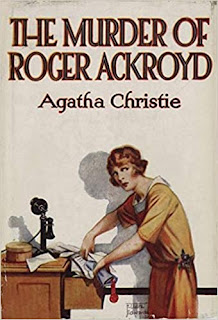
The Murder of Roger Ackroyd, first UK edition dustjacket cover
Roger Ackroyd appears: The first UK edition

Today, the trope of the unreliable narrator is one of the most clichéd in fiction—a device you can spot coming a mile off, whenever there's reasonable doubt to suspect that it's been introduced. However, for authors, it is a far trickier prospect to execute successfully than many may be led to believe initially. In particular, Christie's treatment of the trope in The Murder of Roger Ackroyd, is all about subtlety. After all, this is not a case of a central character simply spouting outrageous lies and later getting exposed. The genius of The Murder of Roger Ackroyd lies in the culprit's expertise in managing and controlling the flow and revelation of information as he deems fit—he may be reticent and picky about what strands of information he chooses to expose judiciously and cunningly, but never does he lie outright.

How, then, does one adapt a work whose virtues have become all too familiar to the audience and still keep it fresh? It's not an easy task, as is evidenced by the failure of David Suchet's Poirot (2000) in doing justice to The Murder of Roger Ackroyd. In its quest to present something new to the viewers and mark itself as something very different from Christie's work, this particular TV episode does away with all the key features that made the novel such a landmark one in the first place. Character roles are changed drastically, events are inexcusably altered, and to cap it all off, the conclusion fails to pack the desired punch.

However, Japanese author, screenwriter and director Kōki Mitani's adaptation of The Murder of Roger Ackroyd, titled Kuroido Goroshi (2018), succeeds where Suchet's fails. Among literary circles, Mitani is popular and much beloved for his mystery and comedy works, one of which is the excellent TV series, Furuhata Ninzaburō (1994–2006)—in many ways, the Japanese version of Richard Levinson and William Link's legendary inverted mystery series, Columbo. All of his trademarks are also present, in varying degrees, in Kuroido Goroshi—a TV special that offers some clues on how to adapt a tricky work such as The Murder of Roger Ackroyd correctly and proficiently.

As is the case with Furuhata Ninzaburō, one can sense Mitani's love and respect for the source material in Kuroido Goroshi. Instead of 1920s countryside England, one is transported to the picturesque village of Tonosato in 1952 Japan—a setting that most reminds me of fictional Midsomer (in Midsomer Murders) with its gossipy villagers and sleepy manors and cottages sheltering dark secrets. The adaptation is very faithful to the novel and the events that transpire henceforth should therefore be familiar to most readers who are acquainted with Christie's book. Additionally, Mitani gives a few distinctive touches—strengthening the portrayal of characters, making the motives behind their actions meatier and making it more difficult to guess whodunnit, making subtle changes to the timeline of events, more foreshadowing, introducing characters that would make sense in a Japanese setting, among others—that significantly contribute to the lasting legacy of the work.

The film opens with an interaction between Takeru Suguro (the Hercule Poirot equivalent) and Dr Heisuke Shiba (Dr Sheppard's character) in Tonosato village (similar to King's Abbot). Heisuke happens to be the only practicing doctor in the village who, on the side, has been writing a manuscript investigating the circumstances of the death of Rokusuke Kuroido, one of the notable personages in the village and a close acquaintance of Heisuke. It is through the pages of Heisuke's manuscript (that is handed over to Takeru in the opening few minutes of the film) that we see the film's narrative unfold as well. This narrative-within-a-narrative treatment, along with the help of a clever shifting timeline, allows Mitani to portray one of the most difficult aspects fairly well (but not flawlessly—things get a wee bit muddled towards the end).   

Rokusuke's murder happened in mysterious circumstances after a family dinner to which Dr Shiba had also been invited. Later, Takeru is called in to solve the mystery by Rokusuke's niece Hanako, while Heisuke, who was completely unaware of Takeru's reputation as a meitantei (great detective) at this time, becomes his Watson. The TV special reconstructs the events of the novel without skipping on too many details—Heisuke being invited to Rokusuke's study for a secret conversation with the secret remaining unsaid, a lot of curious incidents involving the other occupants of the house around the estimated time of murder, a rather small but strange change in the arrangement of a particular piece of furniture at the site of crime (Rokusuke's study) which is then reverted to normal, a mysterious phone call to the doctor's house that leads to the corpse's discovery in the first place and the suspicion ultimately falling on Rokusuke's stepson Haruo are exact replicas of what happens in the book. 
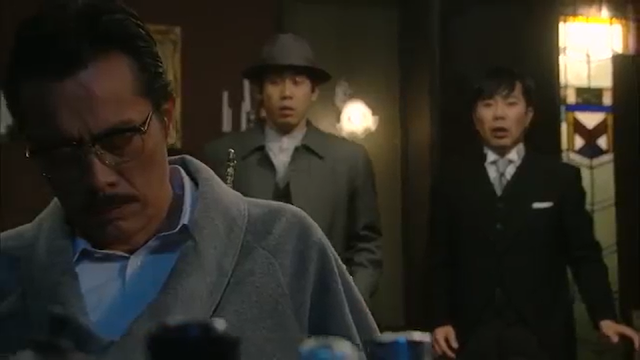
The death of Rokusuke Kuroido in Kuroido Goroshi
Roger Ackroyd dies again, this time as Rokusuke Kuroido

All of this sounds rather heavy and foreboding. Moreover, there are too many innocuous, inconsequential distractions all cluttered roughly around the same time as the murder that threaten to take one's attention away from the central plot. But, in Mitani's hands, these turn out to be the perfect spots to bring in comic relief. No doubt, the comedy and parodic elements are sometimes laid on a bit too thick for my taste, but segments such as the absconding Haruo's reappearance in the village before the shocked sister of Haruo, the childish tantrums of Rokusuke's spoilt sister, the village police inspector indulging in a bit of fanboyish admiration of the famous ex-detective Takeru and Rokusuke's overeager secretary completing every sentence and observation of the inspector (before the latter has the chance to do so) much to his annoyance genuinely strive to put a smile on one's face. The revelations are also done in a lighthearted manner, resulting in a special that competently balances a serious investigation with comic storytelling, barring some excesses. 

Still, Mitani shines brightest when he puts sombre touches on his portrayal of events and characters. This becomes all too evident during the conclusion when, despite all his eccentric mannerisms, Takeru is finally dispel all the chicanery and the facades to reveal the true nature of the case. We are then left with the culprit all to himself contemplating suicide, his thoughts serving as an epilogue to the episode and the manuscript with which it opens. The extra-layered motive behind the culprit's necessary actions lends Mitani's adaptation a human quality easy to empathise with, which is completely absent in Christie's original. The final fates of the doctor and, especially, his ebullient, gossipy sister leave one in a reflective, poignant, even mournful, mood in sharp contrast to all the humour and adrenaline-pumping fun experienced during Takeru's deductions.

The way the story unfolds also lends itself to a comparison with another manor mystery (an adaptation of another book, by the way) I had watched and reviewed some months ago—Akuma ga Kitarite Fue wo Fuku. This Kosuke Kindaichi mystery unravels in real time (barring a few flashbacks), with the telltale clues, conversations observations and the reasoning leading to the deductions all laid bare before the reader, before the grand deduction leads the detective to reveal the even deeper mystery of 'what really happened' which even the culprit wasn't aware of. There's little by way of distractions and the focus on the core mystery is really intense leaving little else to the imagination. Kuroido Goroshi, on the other hand, transitions from the past to the present within the pages of a manuscript presenting a mix of limited first-person and third-person perspectives. Side plots abound in plenty, most of which are tied to the main storyline with the flimsiest of threads, but which, at times, threaten to steal all the limelight for themselves. The main trick is a neat one, involving a nice bit of deception involving [SPOILERS AHEAD] a dictaphone, a telephone call, and a strategically placed chair and pile of books, the combined effect of all these evidences successfully leading the investigators to wrongfully estimate the time of death. 

But, the real charm of Kuroido Goroshi lies in its depiction of the battle of wits between the culprit and the meitantei. Unlike Akuma ga Kitarite Fue wo Fuku, Kuroido Goroshi does not exactly show the ace detective's thinking (or rather, his little grey cells in action). Even though the clues leading to said thoughts are all presented in order, there's a jump between their presentation and the accurate inference during the deduction scene. Like many of the audience members, one is surprised and left to wonder how Takeru chanced upon the exact interpretation of said clues to deliver a remarkably correct inference. Seen in isolation, it can be quite frustrating and seen as not quite fair to the reader. But, when one keeps in mind the overarching theme of the novel and this adaptation, this treatment makes sense and is, in fact, deliberate. As mentioned previously, the main theme of both the novel and this adaptation is that of deceiving readers and viewers through cleverly concealing information, revealing the bare minimum, and never by outright lying. And since the excessively modest culprit chooses to be courteously evasive throughout and reveals only bits and pieces about his participation in the events and his thoughts on the investigation, so does Takeru. Takeru needs to beat the culprit at his own game—and so, he never reveals his ways of thinking and reasoning to even his closest associates or the viewers. Not surprisingly, this explains the jump between observation and deduction (which mostly happens off-screen) as not even the author of the manuscript is privy to these details in the first place. It is a very effective ploy befitting of the master detective, which goes on to surprise and draw the real culprit out of his shell who finally 'confesses' to his wrongdoing and his underestimation of Takeru in the end.

Takeru Suguro reveals the reason behind Dr Shiba Heisuke's actions in Kuroido Goroshi and the truth of his sister's illness
Takeru Suguro: Japan's Hercule Poirot

Kuroido Goroshi is not the only TV special where Mitani has showcased his brilliance in adapting the Dame's works. Prior to this, he adapted Murder on the Orient Express (in 2015) as a two-episode TV drama special featuring Takeru Suguro. While the first episode shows the events of the novel unchanged, the second is a splendid imagination and portrayal of how the perpetrators were going about their lives and daily duties in the lead-up to the murder on the train—a completely new perspective and behind-the-scenes look entirely absent in the novel. And after Kuroido Goroshi, he has also adapted Appointment with Death (Shi to no Yakusoku, 2021) which I am yet to see. Seen as a tribute to one of Christie's iconic works or as a standalone TV special in its own right, Kuroido Goroshi is deserving of several rewatches. One hopes that the same is true of the rest of Mitani's Christie-based output. Whatever may be the case, based on my fervid enjoyment of Kuroido Goroshi and my currently skyrocketing expectations, I plan to write more on Mitani's works, as and when I come across them.